
 ,
,


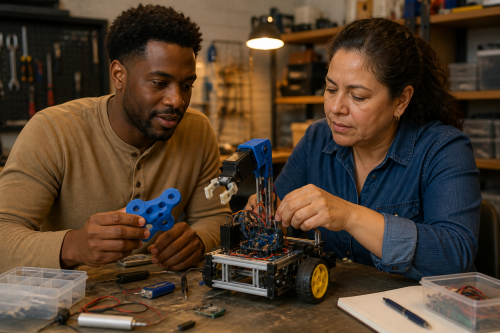
A prototype does not have to be attractive or complete. The first goal is to test one uncertainty: does the mechanism fit, can the signal be measured, does the sensor work, will the material hold, or does a user understand the controls?
Breaking large ideas into small tests reveals much faster what works and what does not. The successful parts can then be combined.
Choose one core question. A cardboard model can test dimensions, a breadboard the electronics, a 3D print the fit and a simple script the logic. Do not build everything at once while the biggest uncertainty is still unknown.
CAD is useful for dimensions, repeatability and parts that will later be changed. Hand work is often faster for a rough first trial. Use the method that answers the question fastest.
Keep sketches, dimensions, component numbers, software version, test results and the reason for each change. Photos with notes are often enough to prevent a failed step from being repeated later.
3D printing, Electronics, Digital, Metalworking, Woodworking and Science and experiments can all play different roles in one prototype.
Copyright © 2026, ASK-Solutions


