
 ,
,


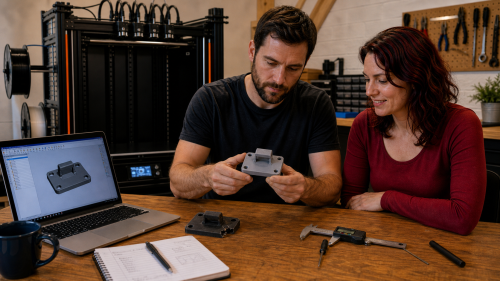
3D printing is not a magical copying machine. First a usable model has to be made or found, and then material, orientation, fit and load have to be chosen.
A strong PLA part may deform in a hot location; a beautiful resin model may be too brittle for a snap fit. The application determines the print choices.
No. High temperature, large structural loads, food contact, electrical insulation or safety-critical functions may require other materials or production methods. A printed prototype can still be useful for testing dimensions and form.
Measure the functional geometry and build the model parametrically where possible. Account for tolerances, printer shrinkage and post-processing. Scanning can help with organic forms, but dimension-critical features often still need to be modelled.
FDM parts are anisotropic: layer adhesion is usually weaker than strength within the print plane. Orient loads and critical surfaces deliberately and use supports only where needed.
3D printing includes both design and filament and resin printing. Digital model preparation can also touch Digital.
Copyright © 2026, ASK-Solutions


