
 ,
,


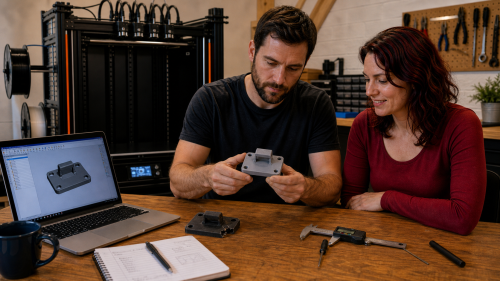
Replication starts with measurement, but a caliper does not automatically reveal the original design intent. Wear, clearance and deformation can mean the old part no longer has its original dimensions.
Make a first model, test the fit and adjust deliberately. For a one-off part, hand work may be faster; for repeatability, a digital model is often valuable.
Not only the outer dimensions. Measure holes, centre distances, thicknesses, fits, threads, stops and the relationship to surrounding parts. Record which dimensions are critical and where clearance is deliberately required.
Compare with the mating part or a second example if possible. A worn hole may be larger than intended; a worn lug smaller. Design for function and fit rather than blindly copying the damaged dimension.
Not always. A cheap prototype can test size and form before a stronger or more expensive material is used. Be aware that material behaviour can affect fit.
Depending on the part, 3D printing, Metalworking, Woodworking and Basic repair are relevant.
Copyright © 2026, ASK-Solutions


