
 ,
,


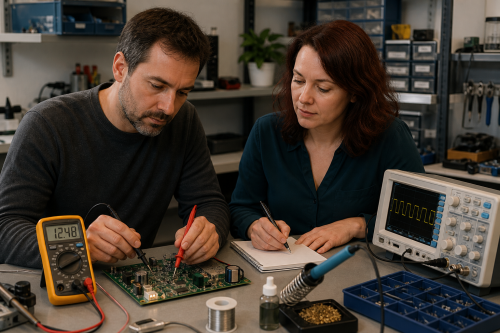
Measurement is useful only when it is clear what the instrument is actually measuring. Voltage is measured between two points; current flows through a path and therefore requires a different connection. An oscilloscope also has a reference connection that can be safety-critical on mains-powered equipment.
Start with the expected order of magnitude and then choose the instrument, range and connection method.
In current mode, a multimeter has a very low internal resistance. Connecting it in parallel can therefore create almost a short circuit and damage a fuse, meter or circuit. Current is normally measured in series or with a suitable current clamp or shunt.
DC concerns a steady component; AC concerns a varying component. With complex waveforms, the meaning of an AC measurement depends on the instrument and whether it measures true RMS. An oscilloscope can make the waveform visible.
For timing, pulses, communication, ripple, oscillation or fast disturbances that a multimeter does not show. Choose bandwidth and probe to suit the signal and pay attention to the oscilloscope ground connection.
The electricity workshop covers basic electrical knowledge; for electronic measurements, Electronics and Science and experiments are relevant.
Copyright © 2026, ASK-Solutions


