
 ,
,


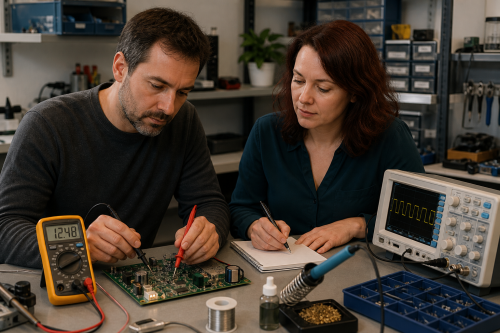
A device that “gets no power” can have a problem before the power supply, in the power supply or after it. A failed fuse is also often a consequence rather than the original cause.
With mains voltage and high energy, safety is part of the diagnosis. Not every device is suitable for live open-case measurements without the right knowledge and equipment.
Because a fuse may have blown because of a short circuit, failed semiconductor or another overload. First investigate why the current became too high. Fitting a higher-rated fuse to “solve” the problem is dangerous.
Measure the output voltage and, where useful, ripple while a known suitable load is connected. Some power supplies appear fine with no load but collapse as soon as current is demanded. Use a load within the specifications.
With unfamiliar mains-voltage sections, damaged insulation, high-voltage capacitors or equipment with high fault energy when you do not know exactly how to measure safely. In those cases, use specialist help.
The electricity workshop is relevant here; electronic power supplies also fit Electronics.
Copyright © 2026, ASK-Solutions


