
 ,
,


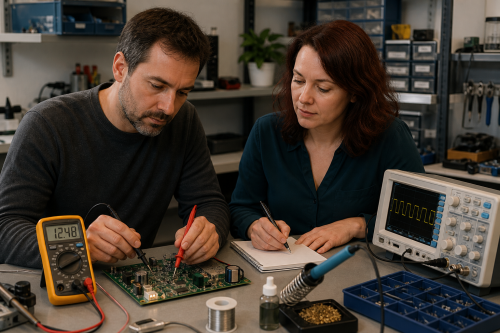
Electronic diagnosis is not a search for “the broken component” without context. First establish which function is failing, which supply voltages are present and which part of the circuit performs that function.
Visual inspection, a schematic or datasheet, current limiting and measurements build a fault picture together. Sometimes the problem turns out to be a connector or cable before a single IC is touched.
Start with power and the ground reference. Find the input, fuses, regulators and visible damage. Measure first without placing probes at random in unknown high-voltage sections, and use current limiting or isolation where appropriate.
A multimeter usually gives an average or RMS value; an oscilloscope shows change over time, ripple, pulses, oscillation and interference. On digital lines or switching power supplies, that difference can be crucial.
No, but a schematic can speed diagnosis considerably. Without one, functions can be traced through components, datasheets, reference designs and continuity measurements. Document what you discover so the same board is easier to understand later.
Electronics and Science and experiments connect directly to this. For practical soldering work there is also the soldering workshop.
Copyright © 2026, ASK-Solutions


