
 ,
,


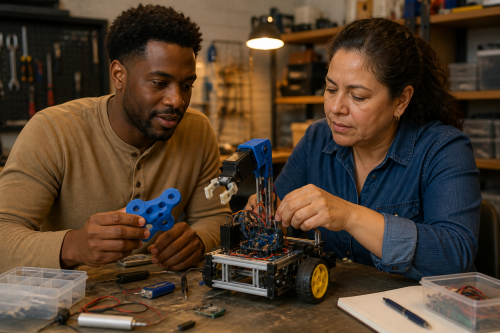
Connecting a sensor means more than finding the right connector. Supply voltage, signal level, protocol, timing and common reference all have to match.
Software then has to interpret the measurement meaningfully, and an actuator or output must be driven safely. Test each part separately before connecting everything together.
Read the datasheets: supply range, logic levels, current consumption, output type and protocol. A 5 V output can damage a 3.3 V input; open-collector or open-drain outputs often require a pull-up.
That depends on distance, speed, number of devices and available hardware. I2C is convenient for several local sensors, SPI for higher speed and UART for simple point-to-point communication. Industrial environments may require more robust interfaces.
Not directly from a microcontroller pin when the current or voltage is too high. Use an appropriate driver, transistor or MOSFET, relay module or interface and protect against inductive kickback where necessary.
Electronics, Digital, 3D printing and Science and experiments can come together here.
Copyright © 2026, ASK-Solutions


