
 ,
,


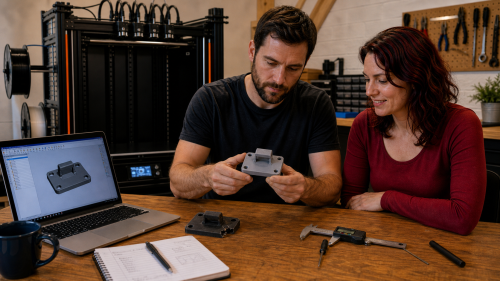
A material is not simply “strong” in general. It can be strong in tension but brittle under impact, poor at high temperature or prone to creep under long-term load.
Look at the real environment: temperature, moisture, UV, chemicals, friction, screw loads and how often a part is moved.
A test fit with a simple prototype often prevents an expensive final part from being just slightly wrong.
Look at load, shape, available processing and desired lifetime. Plastic suits many complex shapes, metal offers high stiffness and temperature resistance, and wood suits other structural and aesthetic applications. Combinations are often sensible.
The permitted variation around a dimension. Two parts with exactly the same nominal size do not automatically fit in practice; sliding, clamping, press fits and rotating fits each require suitable clearance or interference.
Because the machine, material and measurement method all introduce deviations. A small fit test uses little material and can reveal the correction needed for the chosen printer or process.
3D printing, Metalworking, Woodworking and Science and experiments can combine material choice and testing.
Copyright © 2026, ASK-Solutions


