
 ,
,


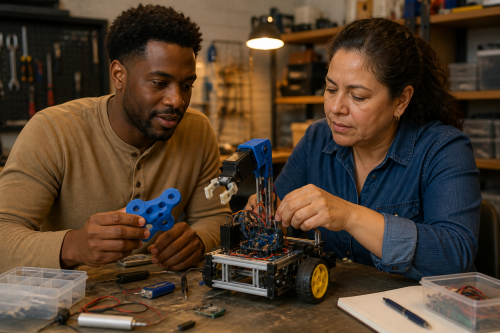
A measurement setup is useful only when it is clear which question it should answer. Without a hypothesis or measurement goal, it quickly becomes a collection of sensors and graphs without meaning.
Define the quantity, range, accuracy and conditions first. Then build the simplest setup that can test the question and document the configuration.
Make it concrete: not “how hot does this get?”, but for example “what temperature does component X reach after 20 minutes at load Y and room temperature Z?”. That makes sensor placement and measurement duration determinable.
Resolution is the smallest step a system can display; accuracy describes how close the value is to reality. Many decimal places therefore do not automatically mean a good measurement.
To recognise systematic deviations and correct them where possible. For a simple comparison, relative consistency may be sufficient; for absolute claims, traceability matters more.
Science and experiments, Electronics, Digital and 3D printing can combine measurement mechanics, electronics and logging.
Copyright © 2026, ASK-Solutions


